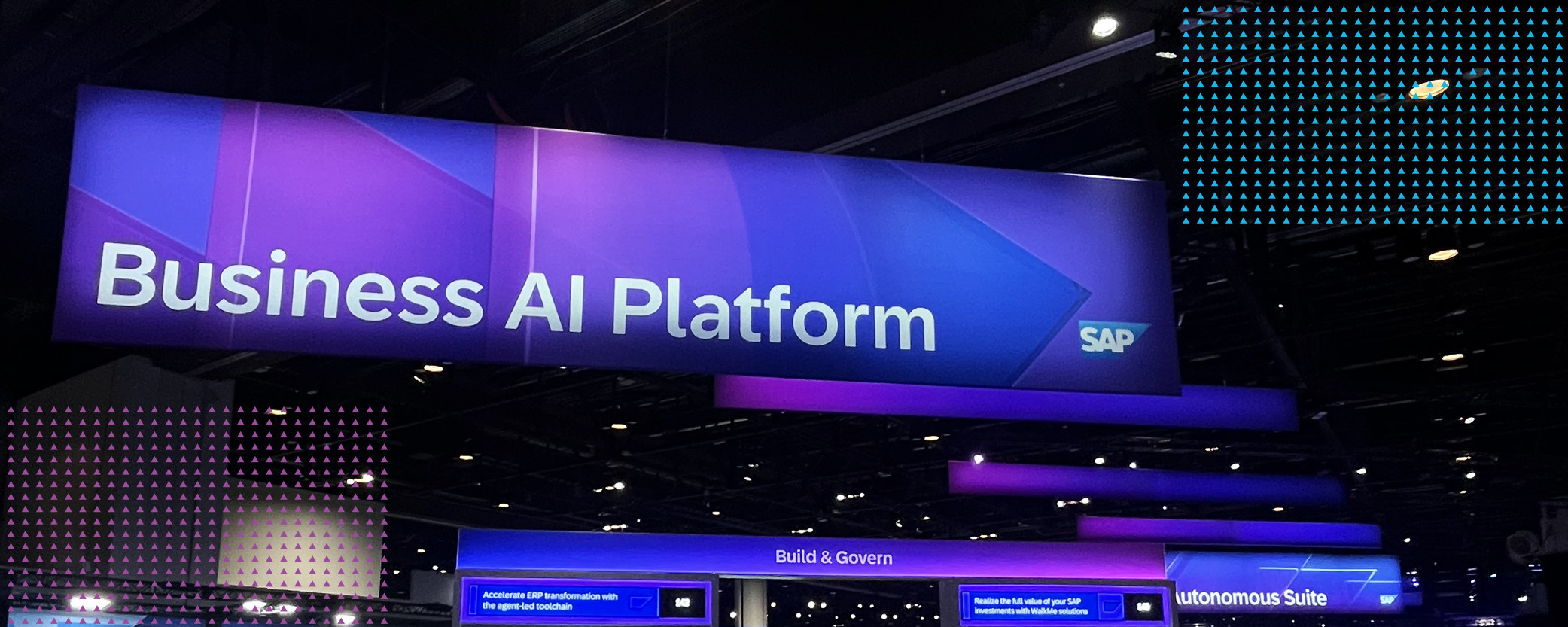
From the expanded role of Joule to the broader SAP Autonomous Suite and the introduction of the SAP Business AI Platform, what stood out most was SAP’s vision—and fundamental shift as business—to move AI into the operational fabric of the enterprise.
From AI Features to an AI Operating Model
One of the clearest themes at SAP Sapphire 2026 was that enterprise AI needs more than model power. It needs context—process context, data context, and governance context—if it is going to deliver meaningful business outcomes. SAP made that point explicit with the launch of the SAP Business AI Platform, a unified architecture that brings together SAP Business Technology Platform (BTP), SAP Business Data Cloud, and AI Foundation. The significance of the announcement was not only technical. It was strategic.SAP reinforced the point further through the SAP Autonomous Suite, extending AI agents and assistants across core business domains such as finance, spend, supply chain, HR, and customer experience.
Foundations: Why Readiness Comes Before Autonomy
Two other throughlines at SAP Sapphire 2026 reinforced a key point: the Autonomous Enterprise is as much an operating-model shift as a product story. The first was governance. SAP’s message was not only about making AI more powerful, but making it accurate, secure, compliant, and enterprise-ready. Enterprise AI cannot operate as a black box; it must be governed, traceable, and aligned with existing business controls. The second was change. SAP made clear that agentic AI will not deliver value on its own. The move toward the Autonomous Enterprise requires change management, process redesign, and end-user enablement. Introducing AI agents is not enough; organizations still need to define where AI fits, how work changes, and how to balance speed with control.And underneath both is Cloud ERP. Organizations with modernized ERP environments are better positioned to benefit from embedded AI, real-time visibility, and connected workflows.
What This Looks Like in SAP Managed Services
As SAP environments become more interconnected and cloud-based, organizations are moving away from reactive support models toward more proactive and intelligent operations. Syntax’s AI-First Application Managed Services (AMS) reflects that evolution, combining AI-driven automation with deep SAP expertise to help customers detect issues earlier, accelerate resolution, optimize performance, and free internal teams to focus on transformation and innovation. That aligns closely with the broader Autonomous Enterprise theme: AI applied not as a layer on top of operations, but as a way to improve how operations run.“Syntax’s AI-First AMS is already delivering measurable impact. We’ve reduced total cost of ownership, accelerated solution design, and achieved accuracy rates at about 96%. What once took hours now takes an hour or less, giving our team more time to focus on innovation and business growth.” Sara Colella, Director, IT Processes and Continuous Improvement, Novexco
What This Looks Like in Modernization
The same principle applies to the move to SAP Cloud ERP. Many organizations want to modernize but remain constrained by years of customization, fragmented logic, and complex remediation requirements. Used well, AI can change that equation—accelerating analysis, documentation, redevelopment, and code remediation across large transformation programs. Syntax addresses that challenge through our AI CodeGenie Suite, a purpose-built agentic AI development suite that automates some of the hardest steps in moving to SAP Cloud ERP. By helping organizations move faster, stay more clean-core compliant, and reduce transformation risk, CodeGenie Suite turns AI into a practical accelerator for modernization and a foundation for the AI capabilities SAP announced at SAP Sapphire 2026.Industry Context Will Define the Path
One of the more meaningful aspects of SAP’s Sapphire message was the recognition that enterprise AI has to work inside the realities of actual business operations. The path to autonomy in retail, construction, manufacturing, mining, or consumer products will not look the same. Syntax is already helping customers apply that model in practice: from supporting retail growth through SAP Cloud ERP with our GenAI-Powered Retail and Apparel Migration Offering for SAP AFS customers, to helping customers like Hensel Phelps modernize on SAP Cloud ERP Private with Syntax’s agentic AI and deep construction expertise. The value of AI is highest when it is applied in the context of industry processes, operational constraints, and business priorities.“We needed a partner who combines deep SAP knowledge with a genuine understanding of how construction businesses operate. Syntax brings both—and the AI capabilities Syntax and our internal teams have brought to the project are significantly improving how efficiently we’re able to execute our SAP cloud transformation.” Dolores Mears, CIO, Hensel Phelps
Meeting Customers Where They Actually Are
SAP has laid out the vision. The question remains: how do we take customers along on this journey? Industry analysts project that nearly half of SAP ECC customers will still be running legacy ERP beyond 2027. The good news is that SAP has charted a path for SAP ECC customers to start innovating with AI on their RISE journey to SAP Cloud ERP Private. This is the journey Syntax is built to support, enabling them to start realizing value from AI immediately, combining our industry knowledge, deep SAP delivery expertise, and purpose-built AI agents to address the unique context, industry logic, and configuration intelligence of each customer’s specific environment. We help customers bridge the gap and then guide their modernization path to take full advantage of Cloud ERP—to ultimately unlock the future of the Autonomous Enterprise.The Real Takeaway from SAP Sapphire 2026
SAP Sapphire 2026 made the destination clearer than ever: an Autonomous Enterprise where agents reason, decide, and act inside the workflows that run the business. What the event didn’t change is that the journey to get there is going to look different for every customer—and that the value of AI shouldn’t be reserved for the customers furthest along the path. For Syntax, that’s our work. Modernize the SAP estate where the foundation needs it. Strengthen operational support so agents have somewhere safe to land. Bring industry context and customer-specific intelligence into the AI itself. And help every customer start capturing AI value now. The Autonomous Enterprise vision is for everyone. Helping our customers get there, from wherever they actually start, is what we’ve built Syntax to do. To learn more about how Syntax can help you on your AI journey, contact us.Author